Nakanojo Biennale 2025 (第10回中之条ビエンナーレ2025)
山と谷の風景 Mountain and Valley Landscape
During the 2023 Nakanojo Biennale, I traveled through Gunma’s shifting landscapes and felt deeply drawn to the surrounding mountains. Their quiet strength and ever-changing forms-light, rain, mist, wind-felt like mirrors of the human condition.
I wasn’t just observing, but sensing rhythms, light, and silence.
This experience became a turning point in my work. In this se-ries, I aim to capture not only the landscape’s appearance, but also the atmosphere and fleeting moments-sun on stone, wind through trees.
2023年の中之条ビエンナーレ滞在中、群馬の移ろう風景を巡る中で、私は周囲の山々に強く惹かれました。光や雨、霧、風によって刻々と変化するその姿は、人間の在り方を映す鏡のようでした。
ただ眺めるのではなく、リズムや光、静けさを感じ取っていました。この体験は、私の制作に大きな転機をもたらしました。本作では、風景の姿だけでなく、その場の空気感や一瞬の光、風の気配までも表現しようと試みています。一つ一つが、知覚と時間の痕跡であり、静けさと内省を誘うものです。
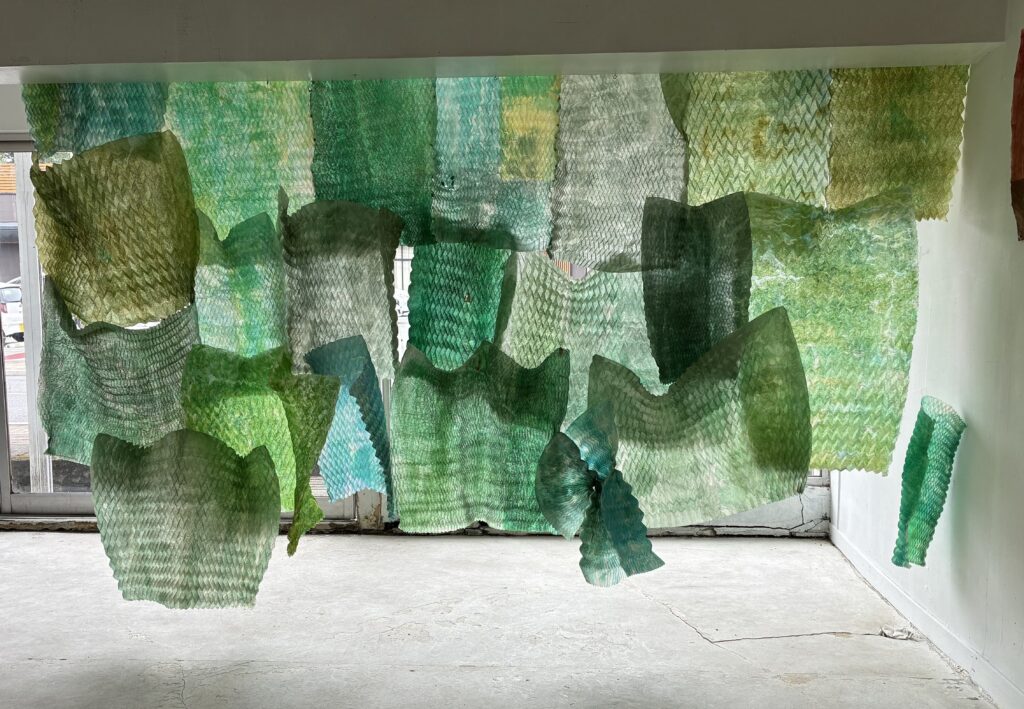
Nakanojo Biennale 2023 (第9回中之条ビエンナーレ2023) : Cosmographia-Tracing the Invisible land
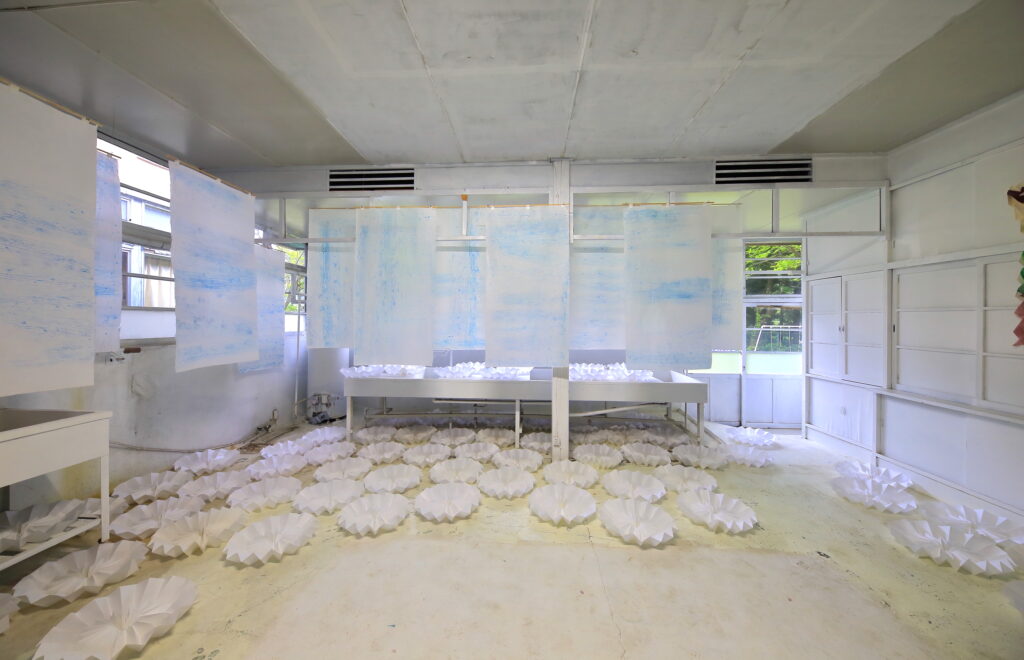
`The landscape of Shima Onsen`四万温泉の風景
My source of creation comes from nature and my ‘theme’ is landscape. I depict realities through my eyes and mind. When I start living in Japan, I wished to stay at an onsen and make artworks without having any pre-conceived ideas or judgements. Finally, my dream came true and I was offered the opportunity to stay at Shima Onsen, which is famous for healing 40,000 diseases, and its surrounding, beautiful nature.
Being at Shima Onsen, I feel that diseases could be curable just for the fact of being in touch with nature. I become a part of nature instead of separated. I feel whole, harmonious and jubilant with the sound of the flowing river and fresh air. I feel purified. I express these experiences, which are like Tao, through my art.
目と心にうつるもの。私の作品は、自然に在るものをモチーフにして、風景を描き出そうとしている。
日本に住み始めた頃、いつか温泉郷に滞在しながら創作をしてみたいと思っていた。山深い里に湧くあったかいお湯につかり、面倒な先入観から解き放たれて、自然と湧いてくるものを表現してみたい、そう思っていた。
この度、念願が叶い、ここ四万に逗留しながら作品を制作し発表するという機会に恵まれた。関係者の皆さまには心より感謝を申し上げたい。
四万(よんまん)の病を癒すと言われる霊泉につかると、周りの山々や川、風に包まれながら、次第にからだが癒されていくのがよく分かる。私自身が自然の中に溶け込み、川のせせらぎや澄み切った空気との完全な調和を探しながら、この土地から湧き上がってくる喜びを受けとめる。
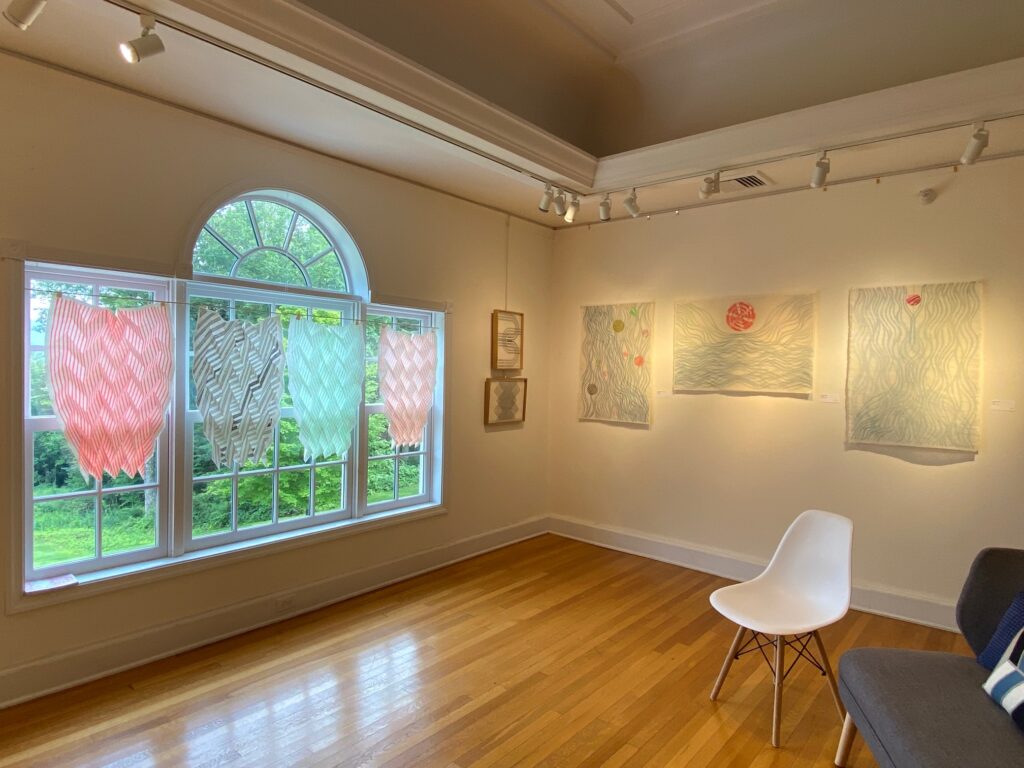
`The Silent Moment` @SVAC in 2021
The very center of your heart is where life begins – the most beautiful place on earth. -by Rumi
How I started Mokuhanga
It was love at first sight when I first saw an exhibition of Ukiyo-e prints when I went to the Ukiyo-e exhibition at the Brooklyn museum in 2000, while I was an MFA candidate at Pratt. I was enchanted by these print works, and I wanted to learn about the process of making them.
In 2003, I was invited to join an artist residency program in Nagasawa Art Park in Japan. During the residence, artists were taught by both a professional carver and printer from Kyoto. I was overwhelmed to learn the process without any knowledge or experience. Ukiyo-e prints were beginning to be made around the 17th century during E-do period in Japan.
The process was separated in three parts; 1. Designed by artist 2. Carving wood blocks by a master carver 3. Printed by master printers. However, today, contemporary artists are doing all three processes by themselves.
In 2004, I moved to Japan, without speaking the language, and with no family or friends for support. After my daughter was born in 2005, feeling isolated and longing to make art, little by little I started to practice Mokuhanga at home, while my baby was sleeping. The best thing about Mokuhanga is that I don’t need a big studio or a printing press to make my work. And, as it is water based, using all natural materials, it doesn’t get messy like painting, and it carries no fumes. I have learned many lessons from my practice of Mokuhanga, not only techniques, but also, life lessons.
About the works
I am open to any expression in Art.
Over the last twelve years. I have concerned myself with landscape, both as abstraction and representational form. Abstraction, to me, is often more realistic than representation. Since I was young, I have tried to visualized imaginary worlds.
For the past 18 years, I have developed my own printing processes,
combined with different methods, such as collage with painting, origami and layered washi. I love Japanese papers, particularly mulberry paper. It is durable yet delicate and feels warm as though I am in nature. When I use mulberry paper, I want to show these qualities in my work. What excites me about printmaking is that I can get the flatness of ink on the surface and that I can repeat patterns.
In 2018, in Tokyo, I exhibited my prints in a solo exhibition. For a long time, I had thousands of reasons to hate myself and suffer. But, after an experience of being showered with sunshine, somehow the sunshine enchanted me to find out who I am. That’s when I began the circle series, which became the basis for my solo exhibition.
Nature is always teaching me both to persist and let go. Making art is the silent moment where I am true to myself and to the practice of letting go. I hope my works will resonate with the viewer, to feel the power of these feelings.
Thanks to
I am grateful to SVAC for giving me this chance, in this difficult time, to share my work at their beautiful gallery surrounded by nature, and to Patty Hudak, for her friendship and helping with the installation of my work. I would like to thank the many master craftspeople in Japan who have passed the traditional process of Mokuhanga and its materials, to myself and from generation to generation. And finally, to my family, who always have patience with me.
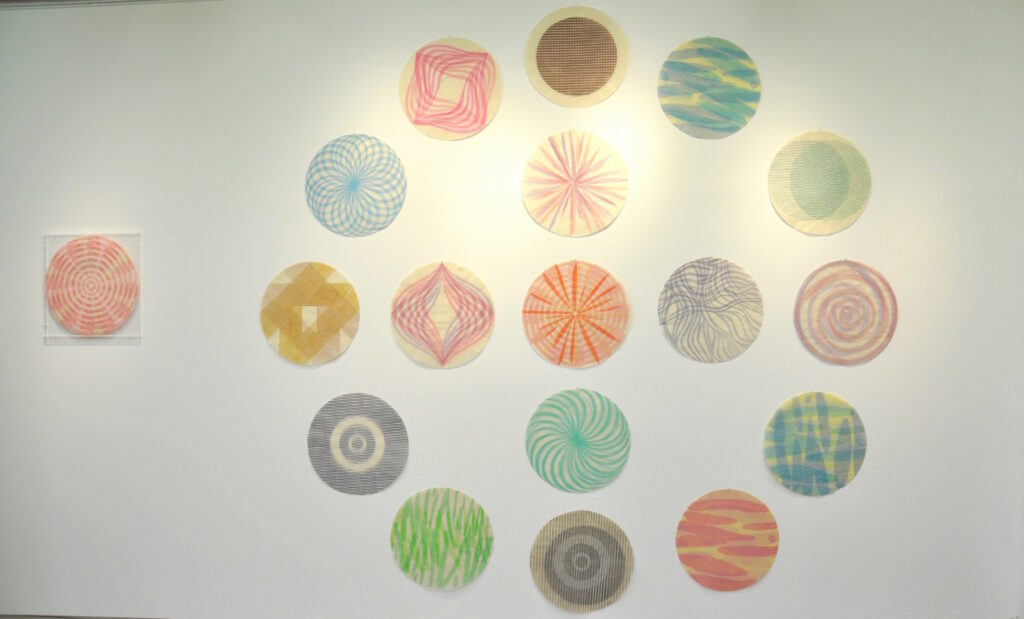
`Present` mokuhanga solo exhibiton @CFSHE Gallery, Tokyo. in 2019
Over the last ten years I have concerned myself with the landscape, more specifically nature, which I feel a great affinity with.
Working with nature gives me a great feeling of satisfaction and fulfilment.
I used to observe landscape with a bird’s eye view. However, I have changed my viewpoint so that I am now looking upwards towards the sun, which I believe has energised me to start producing circular prints.
Whilst I was preparing My first Mokuhanga exhibition in 2016, entitled “Pilgrimage of Landscape”, I played with the crossing and overlapping of lines. This was something I realized that was important to me: unexpected geometric shapes and patterns revealed themselves when I experimented with these line drawings.
I work within the mediums of painting and Mokuhanga printing quite freely, with no parameters. To me, I feel challenged because the way I approach both these mediums, I feel, is in total opposition. However I now realize that painting can influence Mokuhanga, and vice-versa.
When I approach printmaking, I don’t want to simply replicate a drawing or painting. I want the print to be ‘original’ and to evolve naturally and organically. I enjoy the element of unpredictability within the print medium.
I am glad to have learned the Mokuhanga process as it has taught me patience and clarity which has fed into other areas of my life.
Painting Statement (2018~)
When you are near to nature, you see the phenomena of its vitality.
In this exhibition, I am showing my paintings on paper. The conscious state without my thoughts is best expressed through Painting. Just as a plant or a flower does not plan for a certain expression, I seeking a form of expression that exists purely as part of its own being, as Nature intended. I approach my painting as a part of Nature, not as an imitation of it. Although the work may be considered abstract, the colors and patterns are the real feelings surrounding me, so the phenomenon of the work expresses my deep reality. I want to capture the details of minute Natural changes, such the wind, rain, or sunshine, or the cycles of blooming, falling, and decay.